


Mining company Mintails has pioneered a tailings water treatment (TWT) process that can be applied successfully to the problem of acid mine drainage (AMD) in the Western Basin.
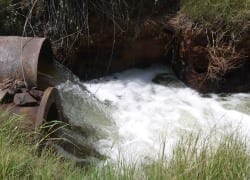
The unprecedented rainfall in the Western Basin over the past couple of months, with 200 mm reported in a single 24-hour period, has overwhelmed the capacity of the Rand Uranium treatment plant to deal with the uncontrolled decant from the 17 Winze and 18 Winze shafts in particular.“To really make an impact on the future treatment of AMD and reduce the void levels, you need to push the treatment to a level that is maintainable, sustainable and manageable,” Mintails CFO Eddie Milne tells Inside Mining on-site at 18 Winze on the West Rand. This means a treatment capacity of 60 Mℓ to 70 Mℓ a day, while Rand Uranium’s current capacity is only 30 Mℓ a day.
“Over the long term, it is about closure mining. This means closing off the void by either halting the ingress of rainwater, or backfilling mined material into the void,” says Milne. So severe is the problem that Mintails argues in its ‘Approach to Closure Mining’ briefing document that “the Western Basin should be considered a national disaster area because of the AMD flows that have breached environmental critical levels.”
Uncontrolled decant
The mining company recently hosted a site visit to the Winze shaft area in order to demonstrate the extent of the uncontrolled decant of what is essentially diluted sulphuric acid from abandoned underground workings. This comprises what is termed a ‘void’.
Jan Jacobs, GM of operations at Mintails, explains that there were originally 12 different reef outcroppings on the company’s current mining right area, of which four or five were mined extensively, thereby creating a void. This dips about 30°, all the way to where it is intersected by the Witpoortjie Fault.
“It is a massive aquifer that has filled up over a relatively short period,” says Jacobs. “The last shaft closed down in 1998, and was overflowing by 2002.” The problem with this water in the void is that if left unmanaged it decants to the surface in the form of highly toxic AMD, which is characterised by a low pH, together with a high concentration of dissolved heavy metals.
Major impact
The decant from the Winze shaft area flows into the Tweeloopies Spruit, which eventually goes underground and then re-emerges in the area of the Sterkfontein caves. “It has quite a big impact on the Cradle of Mankind heritage-site area. From there it ends up in the Limpopo River,” says Jacobs.
Despite the Department of Water Affairs dramatically ramping up the high-density sludge (HDS) treatment plant at Rand Uranium, the heavy rains have meant it has barely coped with the void recharge rate of 27 Mℓ a day. “After the latest rainy season, we are back to square one,” says Jacobs. This means that all the effort and expense that has gone into reducing the level to date has been rendered null and void. However, Mintails is so confident about its proprietary solution to this problem that it is “in advanced discussions” with the DWA to adopt its process.
The TWT process uses AMD that is abstracted from the void and neutralised so that it can be used as process water to mine tailings in the form of slurry. It is a particularly elegant solution that uses the source of one environmental headache, namely AMD, to treat another environmental hazard, the numerous tailings dumps that litter the Johannesburg mining landscape.
Tailings disposal facilities
At present, the mining company has rights to about 100 million tonnes worth of tailings disposal facilities, known collectively as the Randfontein Cluster. The majority of these dumps are clustered around the upper regions of the Wonderfontein Spruit, which drains a highly impacted area focused on the Lancaster Dam.
Jacobs says that more than 80% of the mining company’s total water usage at present comprises treated mine water, compared to a zero base only five years ago. This is believed to be the highest uptake of safely processed AMD in the mining industry to date.
The resultant slurry is pumped back to a processing plant, where it is blended with ore at the mills in order to boost the run-of-mine throughput and thereby increase the profitability. The subsequent blend of recovered tailings slurry and crushed ore forms the feedstock for the carbon-in-leach process. Mintails currently operates a 30 Mℓ a day water treatment plant, but has plans to commission a second 350 000 tonne a day plant, which will increase its capacity to 70 Mℓ to 75 Mℓ a day. “That is the biggest AMD treatment plant there will be,” says Jacobs.
Barren tailings stream
The barren tailings stream is finally disposed of at the West Wits Pit, where the long-term plan is to treat it to grey-water standard for use elsewhere in the economy. Jacobs cautions that such a strategy will only fly if the DWA and Department of Mineral Resources (DMR) collaborate on a regional closure plan for the mining industry, involving one massive tailings dump, as opposed to the 300 dotting the landscape at present.
“This is the only way that such a closure strategy can work: it is about partnerships. If we can forge a partnership with the DMR, we can enforce it. However, we need high levels of cooperation in order for us to be able to achieve this,” argues Jacobs.
Once the tailings have been removed, the site is rehabilitated for future use. Mintails is currently running a nursery project that “feeds directly into our requirements for closure mining. Once we have removed the tailings dam from the surface, what happens to the land at the bottom? You need to rehabilitate, so having a plant-and-tree nursery within the area is important for our vision, and it supports the objectives of the West Rand District Municipality and Mogale City,” comments Milne. “When we enter into a project like this, it is essential that it is sustainable and creates opportunities for both the community and the employees.”
Hydraulic mining
Milne explains further that the tailings dumps themselves are removed by means of hydraulic mining, with the resultant slurry transported to the processing plant via pipeline. Such has been the success of this approach that Mintails has been able to report a 99.72% success rate of all tailings recovered in this manner, with an ultimate target of achieving a <0.25% spillage rate.
Apart from recovering gold from tailings dumps, Mintails also has to contend with a number of surface-striking reef outcroppings in its mining-right area. In general, each of these outcroppings has a hole to the surface every 100 m, due to earlier shallow mining operations that deployed natural ventilation. Not only does this mean that the area is rife with artisanal mining, but that such illegal activities have rendered it geotechnically unstable.
The solution proposed by Mintails to this particular problem is to remove all surface-striking reefs by means of opencast mining, specifically in the form of a long and narrow pit that can be backfilled simultaneously from one end. This not only eliminates the entry points for illegal miners, but also reduces the ingress of the rainwater that results in AMD.
Community consultation
It has not been an easy road for Mintails, which had its Kagiso mining operation suspended by Mineral Resources Minister Susan Shabangu following protest activity by the local community. “We are engaged in further consultation, and have established a community engagement forum,” says Jacobs. We are planning on entering into a memorandum of understanding with the local community in terms of mining in the area. It is going to take time to address some of the legacy issues we are faced with.”
Despite such challenges, Mintails continues to forge ahead with its closure mining approach, which it upholds as a long-term solution to the myriad problems, both environmental and social, faced by the mining industry in South Africa.
“The recent decant from 17 and 18 Winze shafts offers an opportunity to rethink the logic underpinning the solution that has been used until now, by showing that government cannot solve these complex problems alone. Mintails wants to be part of the solution, rather than being part of the problem confronting society as a whole,” it concludes in its briefing document.

