


The Manica gold project, situated in central Mozambique on the Beira Corridor near the town of Manica, holds the potential to emerge as a significant gold producing mine in the region. All it needs is a dedicated and committed company to develop it from exploration through to production, writes Laura Cornish.
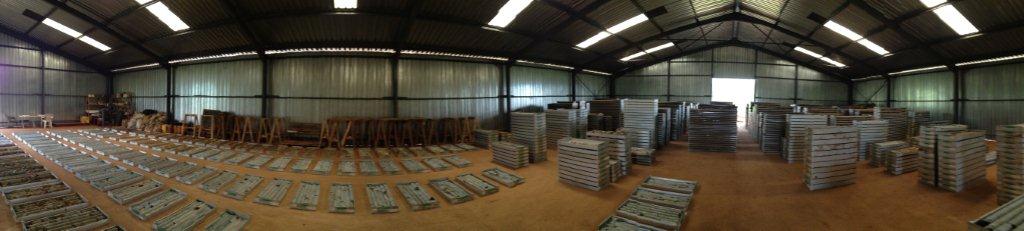
The Manica project, originally owned and explored by JSE-listed gold and platinum mining company Pan African Resources (PAR), has been relatively under-explored for more than a decade. Due to the nature, scope and size of the project, it needed a company capable of devoting every moment to maximising its potential. PAR recently completed the divestment of the project, which led to the creation of a newly branded gold company whose purpose is to move Manica swiftly down the development pathway. This responsibility now belongs to newly established and ASX-listed Auroch Minerals, previously Terranova Minerals. “It is an opportunity and a challenge to put a company together and develop an asset, but we are unwaveringly committed to our cause and will learn and grow as we evolve,” says Auroch MD, Dean Cunningham. Auroch raised US$3 million (R27.3 million) in late 2012 before being re-admitted to official quotation on the ASX in January 2013. PAR, which will retain a maximum stake of 46% in the project and will not divest for two years, remains fully committed to the project. “The appointed team is extremely capable and competent, and I have no doubt this project will develop further now,” says Pan African CEO, Jan Nelson, who has taken a seat on the Auroch board as a non-executive director. “Auroch has retained some of the skills of the PAR experienced exploration team, who have been working on the project since 2002. We have appointed Gordon Koll to run the geological strategy and Jim Porter and Graeme Farr have been appointed as secured contractors for mining and processing, respectively. EPC specialist Basil Read Matomo, which has been assisting us to date, will conduct the feasibility study in due course,” Cunningham outlines. “Considering our junior status, we are particularly proud of our expertise level, which, combined, amounts to 140 years of experience.” The project lies within the relatively unexploited 160 km long Odzi-Mutare-Manica (OMM) classical greenstone gold belt, which extends from Zimbabwe to Mozambique. To date, it has a JORC-compliant resource base of 2.97 Moz at 1.83 g/t gold, located on the eastern limb of the OMM. 87% of the current JORC-compliant resource has been derived from the Southern Shear at Fair Bride, which is predominantly a sulphide resource. Capital raised at the end of 2012 will be used to explore the relatively under-investigated Northern Shear, with a view to growing the resource base with low cost oxide material, which can be recovered by direct cyanidation. Two diamond drill rigs have been on-site on the Northern Shear since November 2012, and TDEM surveys and geochemical mapping will commence in January 2013. “This is a typical Greenstone-belt deposit, which tongues into Mozambique from Zimbabwe. It is the key project in the Manica area, and we hold a 25-year mining concession on the property,” Cunningham outlines. “Historical gold production from the OMM is about 2.5 Moz,” he adds.Looking forward, the immediate, overriding priority is to generate, prove and add another 1 Moz to the current resource base. This requires another full year of drilling, after which Manica will move through the various feasibility stages, and then commence construction and eventually commissioning. Cunningham adds that they are still looking for and evaluating additional property opportunities in the surrounding areas. Nelson believes the project will likely be more viable as a 5 Moz project, which means that a lot of additional exploration drilling is still required.
“Regardless of the length of time it takes to develop this project, we want a ‘sexy’ asset, meaning no compromise on doing things properly.” While it may still be very early days for the project, Cunningham can see the potential for four or five smaller scale mines (initially opencast) all contributing towards a single, central located plant. “We will process the easier oxide material first, in order to start generating cash, but will ultimately blend the oxides and sulphides together through the plant.” Auroch Mineral’s property has access to water and power and will look to employ locally whereever possible. “We will also ensure our contractors employ locals, which will have positive impacts on the area’s sustainability. In terms of logistics, we are 40 minutes from the nearest airport and only 270 km from Beira, with comfortable access to both rail and paved road.” The company has also established an office in the town of Manica. As far as the future is concerned, the Manica gold project is the beginning of the road for Auroch. “We want to be a significant African gold player. We have the skills to analyse and review potential projects when the time comes to expand our portfolio. Manica will, however, remain our primary, medium-term focus.” Sidebar: Cunningham is the right man for the job Dean Cunningham is an experienced mining engineer and corporate financier with over 25 years of experience. Cunningham graduated from the University of the Witwatersrand in 1985 with a BSc (Honours) in mining engineering. He was a stock broker member of the Johannesburg Stock Exchange. He was most recently executive director: corporate finance for Basil Read, where he was largely responsible for the acquisition activity within the group, in conjunction with capital raisings and investor relations. In addition, he held the position of CEO at TWP Investments, the investment arm of TWP Holdings, a mining, processing and energy consultancy company based in South Africa, Peru and Australia. As the head of TWP Investments, Cunningham was charged with the responsibility of acquiring, developing and ultimately listing separately as a mid-tier mining company from TWP Holdings. In this role he was required to review projects both on fundamentals and commerciality, propose transactions and negotiate on behalf of TWP Investments. This role allowed him to have direct access to major South African and international investment banks and gain extensive exposure to a large number of African mining companies, either listed locally or through international bourses.
