


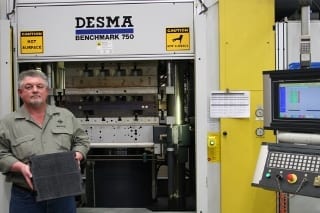
Multotec has purchased a state-of-the-art Desma injection moulding machine capable of producing rubber screen panels up to 7 kg. The new machine features a twin cavity system that makes it possible to produce two products simultaneously and it incorporates a cold runner system.
Multotec‘s Anthony Yell says: “Thanks to recent technical advances, rubber is gradually coming into its own as a viable alternative to polyurethane screen panels in certain applications. A few decades back it was impossible to injection mould rubber to manufacture these products, but today injection moulding techniques have come to the fore as a cost-effective solution where fine apertures are required, making it possible to produce apertures as small as 0.5 mm.” Multotec has been manufacturing a large range of compression moulded rubber screen panels for over 10years, which are generally used in primary, dry screening applications. However, with the purchase of the new machine, the company has now made a significant investment into bringing the injection moulding process on-site to manufacture its smaller apertures in a size range up to 50 mm. Yell says the addition of the new machine is poised to broaden Multotec‘s product range well beyond polyurethane panels, allowing the company to produce a range of modular injection moulded rubber screen panels between 30 and 50 mm thick to complement its compression moulded line-up effectively presenting a full package to the mining industry.“We prepare custom-made moulds to suit both the rubber and the application, where other manufacturers generally use existing polyurethane moulds for their rubber products,” he says. This practice is what has given rubber a bad name when used as an injection moulded screen panel. “Rubber has different characteristics and we cater for this with our in-house design capabilities. Customers who have used these products are extremely happy with their performance.”
Rubber is a rapid growth area for us and we plan to expand more into rubber injection moulding as the market opens up for these products. Rubber is good for impact resistance, while polyurethane is better for sliding abrasion. However, it is the resilience of rubber that makes it so attractive in combating pegging and blinding problems with wet sticky materials. Using rubber at a shore A hardness of between 40 and 60, apertures remain clean. “Rubber also has an excellent lifespan and we’ve proved this in dry ferro-manganese sizing and wet feed preparation applications in the diamond industry. These panels have a comparative life to the polyurethane equivalents, but the reduction in pegging and blinding in certain applications is a significant advantage. In addition, rubber is capable of operating at high temperatures and is inert, performing well in extremely acidic and alkaline conditions.”
